
Exporting garments is a complex business. Every step needs careful planning, and even a small error can cause delays or losses. One part that gets less attention—but is extremely important—is the garment packing list. For many exporters, the packing list is just another piece of paper. In reality, it is a legal document that can make or break a shipment. It helps customs, buyers, and transporters know exactly what is in each box, and it’s essential for customs clearance, insurance, and payment.
If you are new to exporting or want to improve your process, understanding the garment packing list format for export shipments is critical. In this guide, you’ll learn everything about creating, managing, and optimizing packing lists, with plenty of examples and expert advice to make your exports smoother and more professional.
What Is A Garment Packing List?
A garment packing list is a detailed document that lists all the items in a shipment. It describes the content, quantity, size, weight, and packing method for each item. The packing list is usually prepared by the exporter and sent to the importer, the freight forwarder, and customs officials. It helps everyone involved to identify, count, and check the shipment.
Without a proper packing list, your shipment can get stuck at customs, face extra inspections, or even be rejected by the buyer. In the garment industry, where orders are often large and complex, a clear packing list is even more important.
Many people, especially beginners, underestimate just how specific and detailed a garment packing list needs to be. For example, in some countries, customs officers will open random cartons and compare their contents with the packing list. If the numbers or descriptions do not match, it could trigger a full inspection, causing days or even weeks of delay.
This is especially risky with garments because shipments often contain many styles, sizes, and colors, making things easy to mix up.
Another reason the packing list is so vital is that it acts as a final check for your own team. Before the goods leave your factory or warehouse, verifying the packing list ensures that nothing has been left out, and everything is labeled properly.
In the rush to ship, it’s easy to overlook a style or size, but a packing list forces you to double-check.
Why The Packing List Is Essential For Export Shipments
Many new exporters wonder, “Do I really need such a detailed packing list?” The answer is yes—especially for export shipments. Here’s why:
- Customs Clearance: Customs agents use the packing list to verify the shipment. If details are missing or incorrect, your goods may be delayed or fined.
- Buyer Verification: Buyers use the packing list to check that they received the right products in the right quantities, sizes, and colors.
- Insurance Claims: If something gets lost or damaged, the packing list helps with insurance claims.
- Inventory Management: Both exporters and importers use the packing list to update their inventory records.
- Logistics: Freight forwarders and transporters need the packing list to plan loading, unloading, and storage.
In short, the packing list is a critical communication tool between everyone involved in the supply chain.
Let’s dig deeper into each of these points, because understanding the practical effects can save you from costly mistakes:
- Customs Clearance: Imagine your shipment arrives at the port, and the customs officer opens a carton labeled as “Men’s Polo Shirts, Blue, Size M.” But inside, they find a mix of blue and white shirts in both M and L sizes. This mismatch can look like an attempt to hide the real contents or even smuggle goods. Customs may detain your shipment or fine you. In some countries, repeated mistakes can even get your company blacklisted. A clear packing list prevents this.
- Buyer Verification: Many buyers, especially international retail chains, have strict receiving procedures. When your garments arrive, their warehouse staff will check the packing list against the actual cartons. If sizes or colors are missing or extra, they may reject the delivery or claim shortages. This can damage your reputation and delay payment.
- Insurance Claims: If cartons are lost or damaged in transit, your insurance company will ask for the packing list to verify what was lost. If you cannot prove what was packed in which carton, your claim may be denied, leaving you to bear the loss.
- Inventory Management: Both you and your buyer need accurate records. For example, if you ship 5,000 shirts in 200 cartons, but the buyer’s warehouse counts only 4,900, the packing list helps both sides track where the error happened.
- Logistics: Cargo handlers use the packing list to plan how to load and unload the shipment efficiently. If some cartons are heavier or larger, they need to know in advance to avoid damage.
A useful insight: In some countries, even the transport company will not accept your shipment without a signed and stamped packing list. This is because they need to know exactly what they are responsible for carrying.
Core Elements Of A Garment Packing List
Every packing list should include certain core elements. Leaving out information can cause big problems, so make sure these details are always present:
- Exporter Details: Name, address, contact information.
- Consignee (Importer) Details: Who will receive the goods.
- Invoice Number & Date: Reference to the commercial invoice.
- Shipment Details: Vessel/flight, port of loading and discharge, country of origin, destination.
- Order Number/PO Number: Buyer’s reference number.
- Description of Goods: What type of garments, style, fabric, color, etc.
- Quantity and Unit: Number of pieces/sets per carton.
- Size and Color Breakdown: How many of each size and color.
- Carton Details: Carton number, gross weight, net weight, measurements (length, width, height), and total cartons.
- Total Quantity and Weight: Grand totals for the shipment.
- Marks and Numbers: Special marks for identification.
- Signature and Stamp: Signed and stamped by the exporter.
Let’s look at a typical packing list and see how these elements fit together.
More About Each Element
- Exporter/Consignee Details: Double-check spelling and numbers. Customs will compare these with other documents. Even a small error, like a missing zip code or an extra space, can create confusion.
- Invoice Number & Date: This links the packing list to your invoice for payment and for customs’ value assessment.
- Shipment Details: Be specific. Don’t just write “By Sea”—add the vessel name, voyage number, and estimated date of arrival if possible.
- Order Number/PO Number: Many buyers process shipments by PO. If you mix up PO numbers, it can cause payment delays.
- Description of Goods: Use simple, clear terms. “Women’s 100% Cotton T-Shirt, Style #WT-01, Color: Black.” Avoid abbreviations unless the buyer agrees.
- Quantity and Unit: Always state the number of pieces or sets. If your buyer orders by “dozen” or “pack,” mention that.
- Size and Color Breakdown: This is critical for garments. List every size and color, even if there is only a small quantity.
- Carton Details: Give every carton a unique number. Record gross and net weight for each one. Be precise with measurements.
- Total Quantity and Weight: Add totals at the end. This summary helps customs and buyers quickly check the shipment.
- Marks and Numbers: These are the external markings on cartons (buyer’s logo, handling symbols, PO number, etc.). Many buyers have special requirements.
- Signature and Stamp: In many countries, unsigned documents are invalid.
Typical Garment Packing List Format
Below is a sample garment packing list format. This is a simplified example—you can modify it to fit your needs. Notice how each field is clear and easy to understand.
| Field | Example Entry |
|---|---|
| Exporter Name & Address | ABC Garments Ltd., 12 Export Road, Dhaka, Bangladesh |
| Consignee Name & Address | Fashion House Inc., 55 Market St., New York, USA |
| Invoice Number & Date | INV-2024-0012 / 2024-05-14 |
| Order Number / PO | PO-789456 |
| Shipment Details | By Sea, Vessel: Oceanic Star, Port of Loading: Chittagong, Port of Discharge: New York |
| Description of Goods | Men’s Polo Shirts, 100% Cotton, Style #P123, Color: Navy |
| Size & Color Breakdown | M-500, L-600, XL-400 (Navy) |
| Carton Numbers | 1-50 |
| Quantity per Carton | 30 pcs |
| Gross Weight per Carton | 18.0 kg |
| Net Weight per Carton | 17.5 kg |
| Carton Dimensions (cm) | 60 x 40 x 30 |
| Total Cartons | 50 |
| Total Quantity | 1,500 pcs |
| Total Gross Weight | 900 kg |
| Total Net Weight | 875 kg |
| Marks & Numbers | Buyer’s Logo, Carton Number, PO Number |
| Signature & Stamp | Signed by Export Manager, ABC Garments Ltd. |
This format helps everyone in the supply chain understand exactly what is being shipped.
A useful tip: When filling out your packing list, use the same terminology and style numbers as the commercial invoice and PO. If your buyer uses “Style 5678” and you write “Style 5687” by mistake, it may cause confusion during customs clearance or payment.
Also, add page numbers if your packing list is more than one page: “Page 1 of 5”. This prevents pages from getting mixed up or lost.

Credit: garmentsmerchandising.com
Step-by-step Guide To Creating A Garment Packing List
If you want to create a professional packing list, follow these steps:
1. Start With Exporter And Consignee Information
Write your company name, address, and contact details at the top. Add the importer’s (buyer’s) name and address. Make sure spellings and details match the invoice and other documents.
Practical Example:
If your company is “Sunrise Fashions Ltd. ”, always use the full registered name. If your buyer is “Mega Retail Co. ”, don’t shorten it to “Mega Retail”—use the exact name from the contract and invoice.
2. Add Invoice, Order, And Shipment References
Include the commercial invoice number and date, the purchase order (PO) number, and shipment references (like vessel name, port of loading, port of discharge, etc.). These references link your packing list to the other documents.
Insight:
Many customs officers check these reference numbers first. If there’s a mismatch, it can delay the process. In some countries, you must also include the country of origin and the HS code.
3. Describe The Goods Clearly
Describe the garments in simple, clear words. Include the style number, type (e.g., T-shirt, jeans), material (e.g., 100% cotton), and color. Avoid vague terms like “assorted items”—be specific.
Example:
Instead of “Men’s Shirts, Assorted,” write: “Men’s Long Sleeve Shirts, Style #MS-100, 100% Cotton, Colors: Blue, Black.”
4. Give Size And Color Breakdown
List how many pieces of each size and color are in the shipment. For example: “S-300, M-400, L-500, XL-300 (Color: White, Black)”.
Practical Tip:
If you have two colors for the same style, break down by size and color separately:
- “M-200 (White), M-200 (Black)”
- “L-250 (White), L-250 (Black)”
This level of detail helps buyers and customs verify shipments quickly.
5. Carton Details
Number each carton (for example, Carton 1 to Carton 50). Write how many pieces are in each carton, and the gross weight, net weight, and dimensions (length x width x height) for each one.
Example:
Carton 1: 30 pcs (M-10, L-10, XL-10), Gross Weight: 18.0 kg, Net Weight: 17.5 kg, Dimensions: 60x40x30 cm.
6. Calculate Totals
At the end, give the total number of cartons, total pieces, total gross weight, and total net weight. This makes it easy for everyone to check the shipment.
Extra Detail:
It’s a good idea to write both the total per style and the grand total. For example:
- Style #P123 Total: 800 pcs
- Style #P124 Total: 700 pcs
- Grand Total: 1,500 pcs
7. Add Marks And Special Instructions
Mention any special marks or numbers on the cartons. For example, if the buyer requires a logo or a barcode, mention it here.
Insight:
Some countries require “Fragile” or “This Side Up” symbols for certain products. If you have special handling instructions, list them clearly.
8. Sign And Stamp
Always sign and stamp the packing list. Some countries or buyers will not accept unsigned documents.
Practical Note:
Use blue ink for the signature, as some customs authorities do not accept black and white (photocopied) signatures.
Example: Garment Packing List For A Mixed Shipment
Garment shipments often have many styles, sizes, and colors in the same container. Here’s how you can present a mixed packing list.
| Carton No. | Style No. | Size | Color | Qty per Carton | Gross Wt (kg) | Net Wt (kg) | Dimensions (cm) |
|---|---|---|---|---|---|---|---|
| 1-10 | P123 | M | Navy | 20 | 12 | 11.5 | 60x40x30 |
| 11-25 | P123 | L | Navy | 25 | 14 | 13.8 | 60x40x30 |
| 26-35 | P124 | S | White | 18 | 11 | 10.5 | 50x35x28 |
| 36-50 | P124 | M | White | 22 | 13 | 12.3 | 50x35x28 |
At the end of the list, you should total all quantities and weights.
Advanced Tip:
If your buyer uses automated warehouses, they may ask for a separate Excel file with each carton as a unique line item, including barcode numbers or RFID tags.
It’s also helpful to include a legend or note explaining your numbering system if it’s not obvious. For example: “Cartons 1-10 contain Style P123, Size M, Navy; Cartons 11-25 contain Style P123, Size L, Navy, etc.”
Most Common Packing List Formats Used By Exporters
While the basic information remains the same, the packing list format can vary depending on:
- Buyer requirements
- Country regulations
- Transport method (sea, air, land)
- Type of garments
Here are some common packing list formats:
- Simple Packing List: Used for small shipments with one style, color, and size.
- Detailed Packing List: Includes size and color breakdown, carton-wise details, and all weights. Required for large orders and most buyers.
- Buyer-Specific Packing List: Some buyers have their own formats. Always follow their template.
- Electronic Packing List: Made using Excel or ERP systems. Often required for automated warehouses.
- Integrated Packing List: Combines packing list with invoice or delivery note.
Make sure to check buyer and country requirements before choosing a format.
More Detail On Each Format
- Simple Packing List: This is acceptable only for very small shipments, such as samples or gifts. For example: “10 pcs, Men’s T-shirts, Style #TS01, Black, Size L, 1 carton.”
- Detailed Packing List: Most exports need this format. It lets customs and buyers check every detail. For example: “Cartons 1-50, Style #P123, Navy, M-10/L-10/XL-10 each, Gross: 18kg, Net: 17.5kg, 60x40x30cm.”
- Buyer-Specific Packing List: Large retailers and fashion brands often send you a template. For example, Zara, H&M, or Walmart may ask for a special Excel format with unique columns like “Supplier Code,” “Barcode,” or “Department Number.”
- Electronic Packing List: Some buyers have portals where you must upload the packing list file. This helps them automate warehouse receiving.
- Integrated Packing List: Useful for small exporters who want to reduce paperwork. But remember, it must still include all core details.
A non-obvious insight: Some countries (like Saudi Arabia) require the packing list to be in Arabic as well as English. Always check language requirements.
How To Organize Carton Numbers And Marks
Many new exporters get confused about carton numbering and marks. Here’s how to do it right:
- Number cartons in sequence (1, 2, 3…)
- If you have multiple styles, use a code (e.g., C1/P123/M/Navy)
- Put marks (e.g., buyer logo, PO number) on each carton as per buyer instructions
- List the range of carton numbers for each style/size/color in your packing list
This makes it easy for customs and buyers to identify cartons.
Practical Example:
Suppose you have 100 cartons:
- Cartons 1–40: Style #A, Size M, Black
- Cartons 41–70: Style #A, Size L, Black
- Cartons 71–100: Style #B, Size M, Blue
On each carton, print:
- “Carton No: 1 of 100”
- “PO No: 123456”
- “Style: A, Size: M, Color: Black”
- “Buyer: Fashion House Inc.”
This helps warehouse staff sort the cartons quickly and reduces handling errors.
Packing List Vs. Commercial Invoice: What’s The Difference?
Some exporters think the packing list and commercial invoice are the same. They are not:
- The commercial invoice is a financial document. It shows the price, value, and payment terms.
- The packing list is a physical description. It shows what is inside each carton.
Both documents are needed for customs clearance and payment. Never skip one!
Here’s a quick comparison:
| Feature | Packing List | Commercial Invoice |
|---|---|---|
| Main Purpose | Physical details of shipment | Financial transaction details |
| Shows Quantity? | Yes, exact per carton | Yes, usually total only |
| Shows Price? | No | Yes |
| Used for Customs? | Yes | Yes |
| Used for Payment? | No | Yes |
| Signature Required? | Yes | Yes |
Non-obvious Insight:
Some countries (like Brazil) require the invoice and packing list to be on company letterhead with a wet (original ink) signature. Photocopies or digital signatures may be rejected.
Key Points For Exporters: How To Avoid Common Packing List Mistakes
Small mistakes on your packing list can cause big problems. Here are some tips:
- Check Spelling and Numbers: Typos can delay customs clearance.
- Match All Documents: All details (names, addresses, PO numbers) must match the invoice and shipping documents.
- Use Clear Units: Use standard units like “pcs”, “kg”, and “cm”.
- List All Variations: Don’t group “assorted” items—break down by style, size, and color.
- Add All Totals: Double-check total cartons, pieces, and weights.
- Sign and Stamp: Unsigned lists may be rejected.
- Follow Buyer Instructions: Some buyers want packing lists in their own format.
- Keep a Copy: Always keep a copy for your records.
Many beginners forget to write the net weight and gross weight for each carton. This is a common mistake, and customs often reject such packing lists.
More Practical Tips:
- Use Consistent Formatting: If you use decimals for weight (e.g., 17.5 kg), use the same style throughout. Don’t mix “17.5” and “17,5”.
- Don’t Over-Complicate: Too much detail can confuse customs. Stick to what is required, in clear language.
- Include Buyer Codes: Some buyers use internal codes or SKU numbers. If they ask for these, put them on both the packing list and the carton marks.
- Update Immediately After Changes: If you change the packing after preparing the list, make a new packing list. Never send outdated documents.
Digital Vs. Manual Packing Lists
Today, many exporters use digital tools to prepare packing lists. Here’s a quick comparison:
- Manual (Handwritten or Typed): Good for small shipments, but errors are common.
- Digital (Excel, ERP, or Software): Faster, more accurate, and easier to update. Many buyers now require Excel or PDF files.
Digital packing lists reduce human errors and make it easy to share with all parties.
Extra Details:
- Manual Packing Lists: Often used for quick sample shipments or by very small exporters. Risk: handwriting can be hard to read, and mistakes are easy to make.
- Excel Packing Lists: Most common. You can use formulas to total quantities, weights, and even check for errors. Easy to copy and update.
- ERP/Software Packing Lists: Best for medium to large exporters. These connect packing data with inventory, shipping, and invoicing, so mistakes are less likely. Some systems can even generate barcodes and QR codes for each carton.
A useful insight: Some buyers now use automated receiving systems. If your packing list is not digital, it may slow down their process, leading to extra handling fees.
How To Handle Large And Complex Shipments
If your shipment has hundreds of cartons, many styles, colors, and sizes, your packing list will be big. Here’s how to manage it:
- Use Excel or Packing List Software: This lets you organize and filter data easily.
- Break Down by Style/Color/Size: Make a separate section for each.
- Give Summaries: After each section, give totals for that style/color/size.
- Double-Check All Totals: Errors are common when adding up many cartons.
- Use Clear Carton Numbers: Don’t repeat numbers for different styles.
For very large shipments, buyers may ask for barcodes or QR codes on each carton. Some modern ERP systems can generate packing lists automatically with all required fields.
More Guidance:
- Create a Master Packing List: This is a summary sheet with totals for each style, size, and color. Attach detailed carton-wise lists as annexures.
- Keep Digital Backups: Save your packing list in multiple places (USB drive, cloud storage, etc.) To avoid loss or corruption.
- Use Different Tabs or Sheets: In Excel, use different tabs for different styles or POs. This makes editing and checking easier.
A common mistake: Mixing up carton numbers between different styles or POs. Always keep a master list to avoid duplication.
Packing List Templates: Excel, Word, And Software
Most exporters use Excel for packing lists. It’s flexible and easy to calculate totals. You can find many free templates online, but always adjust them for your needs.
Excel Packing List Tips:
- Use separate columns for each field (carton number, style, size, color, etc. ).
- Use formulas to total quantities and weights.
- Lock fields that should not be changed.
Word and PDF Templates:
- Good for simple shipments.
- Harder to edit and total values.
Packing List Software / ERP:
- Best for large exporters.
- Can link with inventory and shipping data.
- Reduces human errors and saves time.
If you want to see a real-life template, visit [Export.gov](https://www.export.gov/article?id=Sample-Documents) for official examples.
More Examples:
- Excel: Create a template where you only fill in the variable details. Use data validation to avoid mistakes (e.g., dropdown lists for style or color).
- PDF: Save your final signed packing list as a PDF before sending it to buyers or customs. This ensures it cannot be changed by mistake.
- ERP: If you use ERP, ask your IT team to build the buyer’s required fields into your packing list template.
A non-obvious tip: For repeat buyers, save templates with their specific requirements, so you don’t have to start from scratch each time.
Regional And Buyer-specific Requirements
Different countries and buyers may have special packing list requirements. For example:
- The EU often requires the HS code and country of origin on the packing list.
- US buyers may want special carton marks for their warehouses.
- Japanese buyers often ask for detailed size breakdowns.
- Some large retailers (like Walmart or H&M) provide their own format and require you to follow it exactly.
Always ask your buyer or freight forwarder if there are special requirements before you prepare the packing list.
More Insights:
- China: Some importers require a detailed description of all materials (e.g., shell fabric, lining, trims) in the packing list.
- Middle East: Some countries require the packing list to be stamped by the Chamber of Commerce.
- Europe: Some retailers require “no wood packaging” statements due to environmental laws.
- Online Retailers: Platforms like Amazon require FNSKU barcodes and special carton labeling.
If you don’t follow these rules, your shipment can be delayed or rejected.
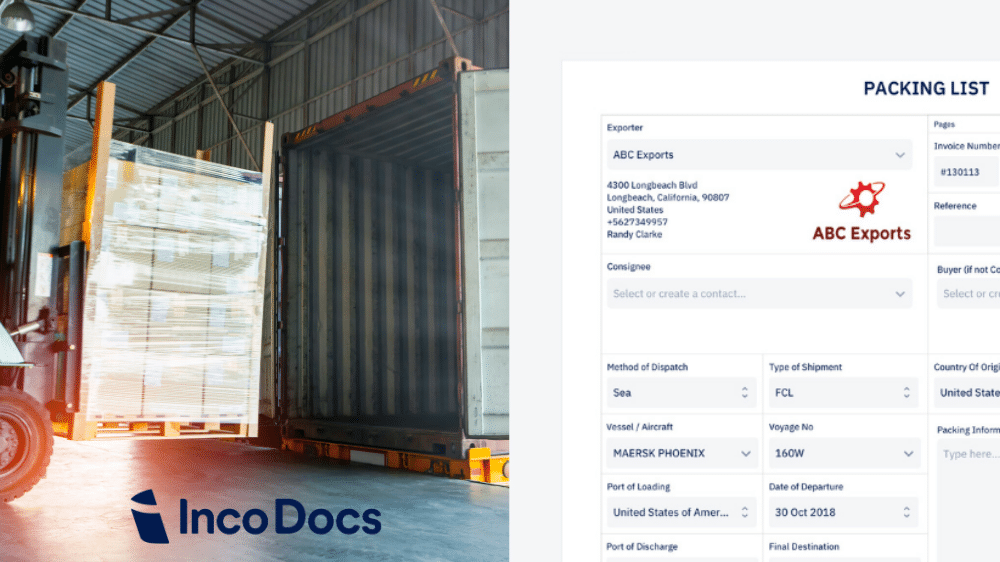
Credit: incodocs.com
Practical Insights For Beginners
Many beginners focus only on the products and forget about documents. Here are some useful insights:
- The packing list is a legal document. Customs can fine you for mistakes.
- Each carton should match the packing list exactly. If you say “20 pcs per carton,” make sure it is true.
- If you change the packing after making the list, update the document.
- Use simple language. Customs officers may not understand technical garment terms.
- Don’t forget to mention “No Wood Packing” if your cartons do not use wood. Many countries have rules about wood packaging.
- If your shipment includes samples or gifts, list them separately.
More Non-obvious Tips:
- Keep an Archive: Save every packing list with the related invoice and shipping documents. This helps if there’s a dispute months later.
- Review with Your Team: Before finalizing, have someone else check the packing list for mistakes. Fresh eyes catch errors you may miss.
- Include Contact Details: Add your export manager’s phone and email. If customs or the buyer has a question, they can contact you quickly and avoid delays.
- Mention Mixed Cartons Clearly: If a carton contains mixed sizes or colors, specify the breakdown. Example: “Carton 23: M-5, L-10, XL-5, Black.”
How To Check A Packing List For Accuracy
Before sending your packing list:
- Compare with Actual Packing: Open a few cartons and check the contents.
- Match with Invoice: Make sure quantities, style numbers, and descriptions are the same.
- Check Weights and Measurements: Use a scale and measuring tape if needed.
- Proofread: Look for spelling and number mistakes.
- Get a Second Opinion: Ask a colleague to review the list.
- Confirm with Buyer (If Possible): Some buyers want to check the draft before shipping.
A careful check can prevent big problems later.
More Practical Advice:
- Spot Checks: Randomly open 5–10% of cartons before sealing the shipment. This catches packing mistakes early.
- Verify Carton Labels: Check if the physical labels match the details in the packing list. If labels are wrong, relabel before shipping.
- Use a Checklist: Make a final checklist for all required fields (exporter, consignee, PO, etc.) And tick off before sending the document.

Credit: template.wps.com
Packing List And Customs: Special Notes
Customs officials in different countries check the packing list for:
- Total quantity and weight matching the invoice
- Clear description of goods (no vague terms)
- No false information or under-invoicing
- Proper marks and carton numbers
If customs finds mistakes, they may:
- Delay the shipment
- Fine the exporter
- Reject the shipment
Always be honest and complete in your packing list.
More Insights:
- Random Checks: Customs may randomly open cartons to check against the packing list. If they find even one mistake, they may inspect all cartons.
- Declared Value: If the packing list and invoice have different totals, customs may suspect under-invoicing and hold the shipment.
- Legal Consequences: In some countries, repeated errors can result in loss of export privileges.
A practical tip: If you’re unsure about customs rules in the destination country, ask your freight forwarder or local chamber of commerce for help.
How The Packing List Affects Shipping Costs
The packing list can also affect your freight costs. Here’s how:
- Weight and Volume: Shipping costs depend on gross weight and carton measurements. Incorrect data can cause extra charges.
- Packing Efficiency: Well-packed cartons save space and reduce costs.
- Carton Size Consistency: Using uniform carton sizes makes loading easier.
If you under-declare weight or use wrong carton sizes, shipping companies may charge you extra.
More Practical Insights:
- Dimensional Weight: For air shipments, freight is often charged by “dimensional weight.” If your cartons are large but light, you may pay more based on volume, not just weight.
- Space Optimization: If you pack odd-sized cartons, you may waste container space, costing you more per piece shipped.
- Palletization: Some buyers require cartons to be palletized. If so, list pallet dimensions and total pallets on your packing list.
A tip beginners often miss: Double-check with your freight forwarder whether to use metric or imperial units (cm/kg or in/lb). Using the wrong units can cause confusion and extra charges.
Common Questions From Buyers About Packing Lists
Buyers often ask:
- Can you send the packing list before shipment?
- Can you use our packing list format?
- Can you add barcodes or special marks?
- Can you list all sizes and colors separately?
- Can you send an Excel and PDF version?
Be ready to answer these questions and adjust your packing list as needed.
More Buyer Requests To Expect:
- Send Advance Copy: Some buyers want the packing list before you ship, so they can arrange warehouse space.
- Attach Packing List to Carton: Some buyers want a copy of the packing list inside the first carton or attached outside.
- Include Country-Specific Details: Some buyers may ask for extra fields (like “country of manufacture” or “import license number”).
- Electronic Data Interchange (EDI): Large retailers may ask you to upload the packing list to their online portal.
Case Study: How A Bad Packing List Caused A $10,000 Loss
A small exporter in Bangladesh sent a shipment of 1,000 T-shirts to a US buyer. The packing list was missing the net weight and had wrong carton numbers. US customs stopped the shipment and asked for a correct packing list. The exporter had to pay extra storage charges, and the buyer canceled the order due to the delay. Total loss: over $10,000.
Lesson: Always double-check your packing list and follow all requirements.
More Real-life Examples:
- Europe: A shipment to Germany was delayed 3 weeks because the packing list did not mention “no wood packaging.” The exporter had to pay demurrage fees.
- Japan: A buyer refused delivery because the packing list did not break down sizes as requested. The exporter had to pay to return and repack the goods.
Frequently Asked Questions
What Is The Difference Between Gross Weight And Net Weight In A Packing List?
Gross weight means the total weight of the goods plus all packing materials (cartons, plastic, etc.). Net weight means the weight of the garments only, without any packing. Always list both, as shipping and customs need this information.
Can I Use The Same Packing List Format For All Buyers?
Not always. Some buyers have their own packing list format and special requirements. Always ask your buyer before preparing the document. If they don’t specify, use a standard format with all the required details.
Is It Okay To Round Carton Measurements And Weights?
No. Always use accurate measurements and weights. Rounding can cause problems with customs and shipping costs. Use a proper scale and measuring tape, and write the exact numbers.
What Happens If The Packing List Does Not Match The Actual Shipment?
If the packing list does not match the actual shipment, customs may delay or reject your goods. The buyer may also refuse to accept the shipment. Always check your packing list against the real packed cartons before shipping.
Do I Need To Put Hs Code Or Country Of Origin On The Packing List?
It depends on the destination country and buyer. Many countries and buyers now require the HS code (Harmonized System code) and country of origin on the packing list. Check with your freight forwarder or buyer to be sure.
What’s The Best Way To Keep Your Packing List Safe And Organized?
Save both electronic and printed copies. Store signed originals in a safe place with other shipping documents. Back up digital files in the cloud, and keep copies for at least five years in case of disputes or audits.
Packing lists are not just paperwork—they are your ticket to smooth, trouble-free exports. By following these guidelines, you’ll build trust with your buyers, avoid costly mistakes, and make your export business more professional. Remember: a clear, accurate packing list is the mark of a skilled exporter.