
When a garment manufacturer receives an export order, the work does not stop at sewing and finishing the products. One of the most important but often overlooked parts of shipping garments internationally is preparing the garment packing list. This document is not just a routine formality—it is an essential part of export documentation that ensures your products arrive smoothly and on time at their destination. Failing to prepare it properly can cause delays, fines, or even rejection of your shipment.
Many new exporters feel confused when they are told to prepare a packing list. What details do buyers and customs officials need? Why do different countries or buyers ask for different formats? Is there a correct way to present garment sizes, colors, or packing methods?
These are all common questions.
In this article, you will learn everything you need to know about how to create a garment packing list for export documentation. You’ll discover why this document matters, what details it must include, the step-by-step process to create one, and how to avoid costly mistakes.
By the end, you’ll be ready to make professional packing lists that satisfy both your buyers and international shipping rules.
Why A Garment Packing List Matters In Export
A garment packing list is a document that gives a detailed summary of the products included in a shipment. It lists what is packed in each carton or box, along with important information such as style, size, color, and quantity.
But why is it so important?
Customs clearance is one key reason. When your goods reach the port or airport, customs officers use the packing list to check if the contents match the invoice and other documents. If there are differences, your shipment might be held or rejected.
Think about a shipment arriving at a busy port. Customs officers do not have time to open every box. Instead, they check the documents. If your packing list matches the invoice and bill of lading, and the details look clear and organized, customs can process your shipment faster.
If there are mistakes or missing details, they may need to open boxes for inspection. This takes time and can also increase your costs.
For buyers, the packing list acts as a receiving checklist. It helps them confirm they received the right products and quantities. Mistakes or missing information can lead to disputes and damage your reputation.
Buyers rely on the packing list to plan their inventory. For example, if they expect 100 pieces of size M shirts but receive only 80, they can quickly see the difference by checking the packing list. If the packing list is unclear, buyers have to spend extra time sorting and counting items, which can slow down their operations and cause frustration.
Freight forwarders and shipping companies also rely on the packing list for cargo planning. It tells them how much space your shipment will need and helps with proper stacking or handling, especially if garments are delicate or need special care.
For example, some garments need to be kept flat, while others can be folded. If your packing list explains how each carton is packed, shipping companies can avoid damaging your goods. The list also helps them assign correct cargo space, which can save you money.
Lastly, the packing list helps you as the exporter. It is your record of what was shipped and a legal document in case of claims or insurance issues.
If a shipment is lost or damaged, you may need to prove what was inside. The packing list becomes your evidence. If the insurance company asks for proof, a detailed packing list can help you get compensation faster. Without a packing list, it’s much harder to resolve disputes.
Non-obvious insight: In some countries, customs uses the packing list to check for restricted or banned items. If your packing list is clear and complete, you reduce the risk of accidental violations.
Key Elements Of A Garment Packing List
A good packing list is more than just a handwritten note with numbers. It must include several key elements to be valid and useful for everyone in the supply chain.
1. Exporter And Consignee Information
Start by clearly stating who is sending the goods (exporter) and who is receiving them (consignee). This includes:
- Full company name and address
- Contact person and phone/email
- VAT or tax registration number (if needed)
This information must match your invoice and other documents to avoid confusion.
If you use different addresses for the invoice and the packing list, customs may question if the shipment is genuine. Consistent information builds trust and reduces delays.
Example:
Exporter: Abc Garments Ltd., 123 Factory Road, Dhaka, Bangladesh
Consignee: Global Fashion Inc., 456 Market Street, Berlin, Germany
2. Invoice And Purchase Order Reference
Always mention the relevant invoice number and purchase order (PO) number. This links your packing list to the correct commercial transaction and avoids mix-ups, especially if you are shipping for multiple orders or buyers.
If a buyer has ordered several shipments from you, referencing the PO and invoice number helps everyone track which products belong to which order.
Practical tip: Some exporters forget to update the invoice number on the packing list when making last-minute changes. Always double-check these references before finalizing.
3. Shipping Details
Include the main shipping information:
- Mode of transport (air, sea, courier)
- Vessel or flight number (if known)
- Port of loading and port of discharge
- Date of shipment
This helps logistics and customs teams track your goods.
Example:
Mode: Sea
Vessel: Mv Ocean Queen
Port Of Loading: Chittagong, Bangladesh
Port Of Discharge: Hamburg, Germany
Date: 20th March 2024
Non-obvious insight: If your shipment is delayed, the shipping details on the packing list help trace its location quickly. This is especially helpful when dealing with transshipment (goods changing vessels at another port).
4. Carton Or Package Details
Each carton (or box) must be clearly identified. For every carton, note:
- Carton number (e.g., 1 of 50, 2 of 50, etc.)
- Total number of cartons in the shipment
- Type of packaging (carton, bale, pallet)
This ensures there is no confusion in counting or locating specific cartons.
Example:
Carton 5/50, Carton Type: Double-wall Carton
If you use different types of packaging (some on pallets, others in cartons), explain this in the packing list. This helps warehouse staff handle the goods correctly.
Practical tip: When reusing cartons, always remove old markings and clearly label new carton numbers to avoid mix-ups at customs or the buyer’s warehouse.
5. Product Description
List the details for the garments packed inside:
- Product style or code
- Description (e.g., men’s T-shirt, women’s blouse)
- Material or fabric type (optional but helpful)
- Color and size breakdown
Be as specific as possible to avoid disputes. For example, “Men’s Cotton Polo Shirt, Style 101, Color: Navy, Size: M.”
Example:
Style: 101
Description: Men’s Polo Shirt
Material: 100% Cotton
Color: Navy
Size: M
Non-obvious insight: If your product has special features (like “anti-wrinkle” or “organic cotton”), mention these. Some buyers and customs need this information for labeling or import rules.
6. Quantity And Packing Method
For each product, include:
- Number of pieces per size, per color, per carton
- Total pieces per carton
- Packing method (e.g., 12 pieces per polybag, 10 polybags per carton)
This helps buyers and warehouse teams check the delivery quickly.
Example:
Each carton: 10 polybags x 6 pieces = 60 pieces per carton
If you pack some cartons differently (for example, sample pieces or promotional items), specify these separately to avoid confusion.
7. Net Weight, Gross Weight, And Dimensions
Shipping companies and customs need to know:
- Net weight (weight of the garments only)
- Gross weight (weight of garments plus packaging)
- Dimensions of each carton (length, width, height in cm or inches)
Accurate weights and sizes ensure correct freight charges and safe stacking.
Example:
Net Weight: 4.2 Kg
Gross Weight: 4.6 Kg
Dimensions: 60 X 40 X 30 Cm
If your weights or dimensions are wrong, you may pay higher shipping fees or face safety problems during stacking.
Practical tip: Always use calibrated scales and measuring tapes. Some countries fine exporters for incorrect weight declarations.
8. Marks And Numbers
Every carton should have marks and numbers—unique codes or labels that help identify them. This is especially important if you are shipping to large distribution centers or multiple stores.
Example:
Mark: “gfi-ber-2024-01” (buyer Initials, Destination, Shipment Number)
Non-obvious insight: Some countries have rules for carton marking, such as showing the country of origin. Check these before shipping.
9. Special Instructions Or Notes
If your shipment has special requirements (fragile, keep dry, stack limit), mention these clearly. Also, note any extra documents included in the shipment.
Example:
“Keep dry. Do not stack more than 4 cartons. Include Certificate of Origin. ”
If you need to send promotional material, samples, or hangtags, mention these as well.
10. Signature And Date
Finally, the packing list should be signed and dated by an authorized person from your company. This makes it an official document.
Some countries or buyers may require a company stamp or seal. Check the buyer’s requirements before sending the documents.
Step-by-step Process To Create A Garment Packing List
Now that you know what goes into a packing list, let’s look at how to actually create one for a real export shipment.
Step 1: Gather Order And Production Information
Start by collecting all the information about the order:
- Purchase order details
- Production plan (styles, sizes, colors)
- Actual finished goods ready for shipping
Check for any last-minute changes in quantity or product specifications.
Example:
PO says 1,000 pieces, but only 980 passed quality control. Update the packing list to match what is actually shipped.
Practical tip: Work closely with your production and warehouse teams to avoid listing products that are not in the shipment.
Step 2: Plan The Packing Breakdown
Decide how you will pack the garments. This is known as the packing breakdown. It depends on the buyer’s instructions and your packing method. There are two main ways:
- Solid packing: Each carton contains only one style, color, and size.
- Assorted packing: Cartons contain mixed sizes or colors.
For example, if you have 1,200 men’s T-shirts in 3 sizes (M, L, XL), you might pack:
- 400 pieces of each size
- 20 cartons total, each with 60 pieces (20 M, 20 L, 20 XL per carton)
Non-obvious insight: Some buyers want “pre-pack” cartons (for example, one carton contains one complete set for a store). Always check your buyer’s instructions before planning the packing breakdown.
Step 3: Number And Label Cartons
Each carton must have a unique carton number. Use a simple system like 1/20, 2/20, etc., where 20 is the total number of cartons.
Prepare and attach carton labels that show the number, style, size, color, and destination.
Example:
Label: “carton 1/20, Style 101, Navy, Size M, To: Berlin”
Practical tip: Use waterproof labels or marker pens. Shipping can damage paper labels, making them unreadable.
Step 4: Fill In The Packing List Format
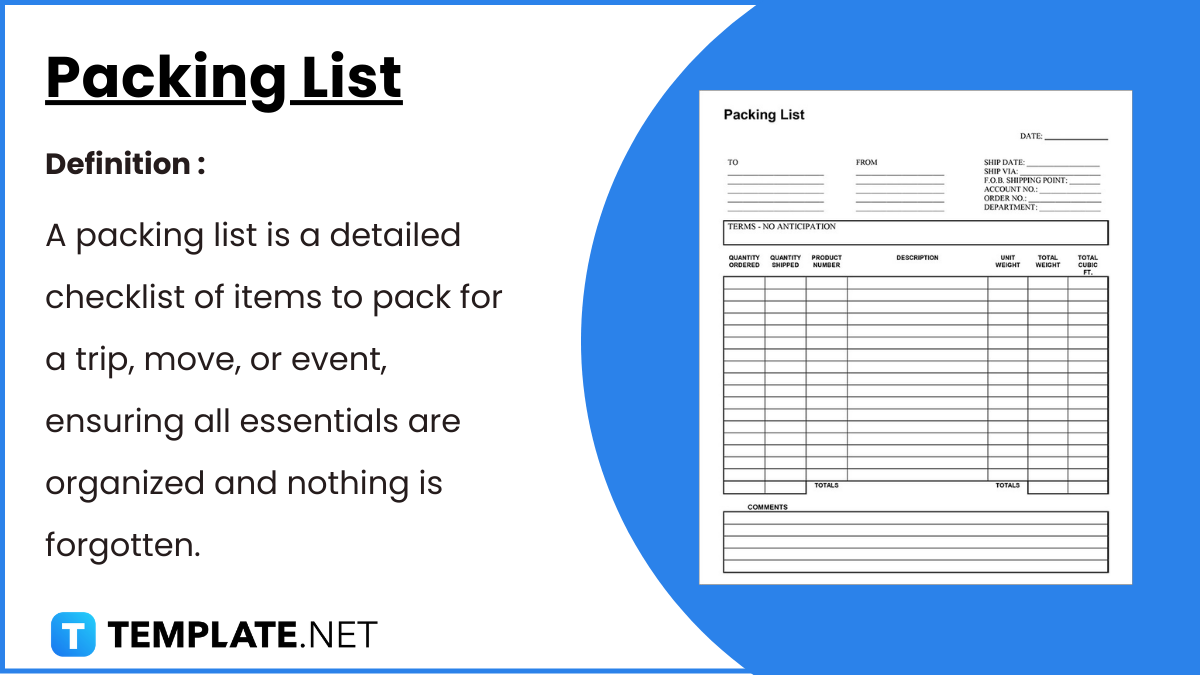
Most garment buyers provide a packing list format or template. If not, you can create one in Excel or Word.
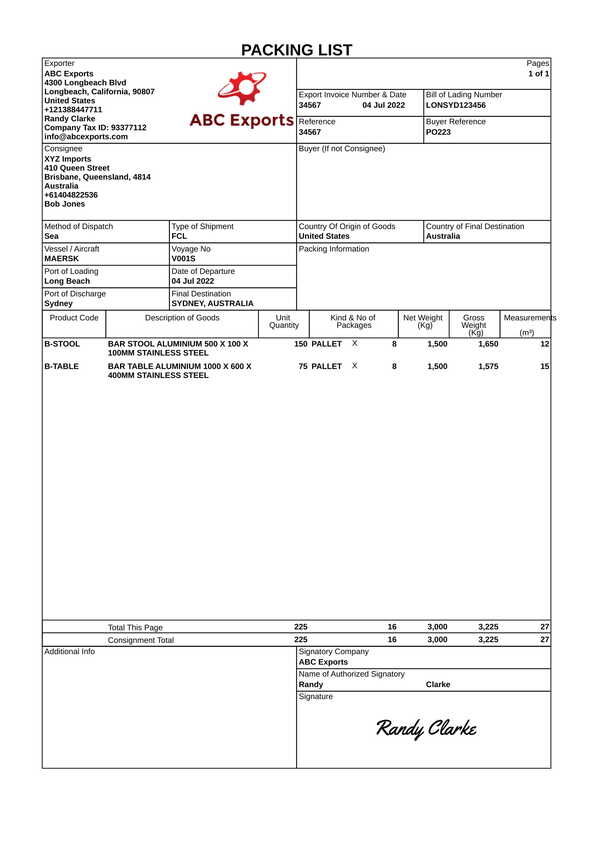
Include all the details covered earlier: exporter, consignee, invoice, shipping details, product description, quantity, weights, dimensions, marks, and signature.
Below is an example of how a basic packing list might look:
| Carton No. | Style | Color | Size | Qty/Carton | Net Weight (kg) | Gross Weight (kg) | Dimensions (cm) |
|---|---|---|---|---|---|---|---|
| 1/20 | 101 | Navy | M | 20 | 4.2 | 4.6 | 60x40x30 |
| 2/20 | 101 | Navy | L | 20 | 4.4 | 4.8 | 60x40x30 |
| 3/20 | 101 | Navy | XL | 20 | 4.5 | 4.9 | 60x40x30 |
Practical tip: If you have many cartons, group similar cartons together in the packing list for easy checking.
Step 5: Double-check For Accuracy
Before finalizing the packing list, check for common errors:
- Do totals match the invoice and PO?
- Are all sizes and colors listed correctly?
- Do carton numbers and labels match the physical cartons?
- Are weights and dimensions accurate?
Mistakes here can cause customs problems or unhappy buyers.
Example:
If your packing list says 60 pieces per carton, but one carton has only 58, the buyer will notice and may ask for compensation or reject the shipment.
Non-obvious insight: Some buyers use automated systems to scan carton barcodes. If your carton numbers do not match the packing list, their system will reject the shipment.
Step 6: Sign, Date, And Share The Packing List
The packing list must be signed by an authorized person and dated. Send it to the buyer, freight forwarder, and attach copies to the shipment.
Practical tip: Keep an extra signed copy in your records. If there is a dispute, you will have proof of what was shipped.
Example:
Signed: John Smith, Export Manager
Date: 18 March 2024
Typical Packing List Format For Garment Export
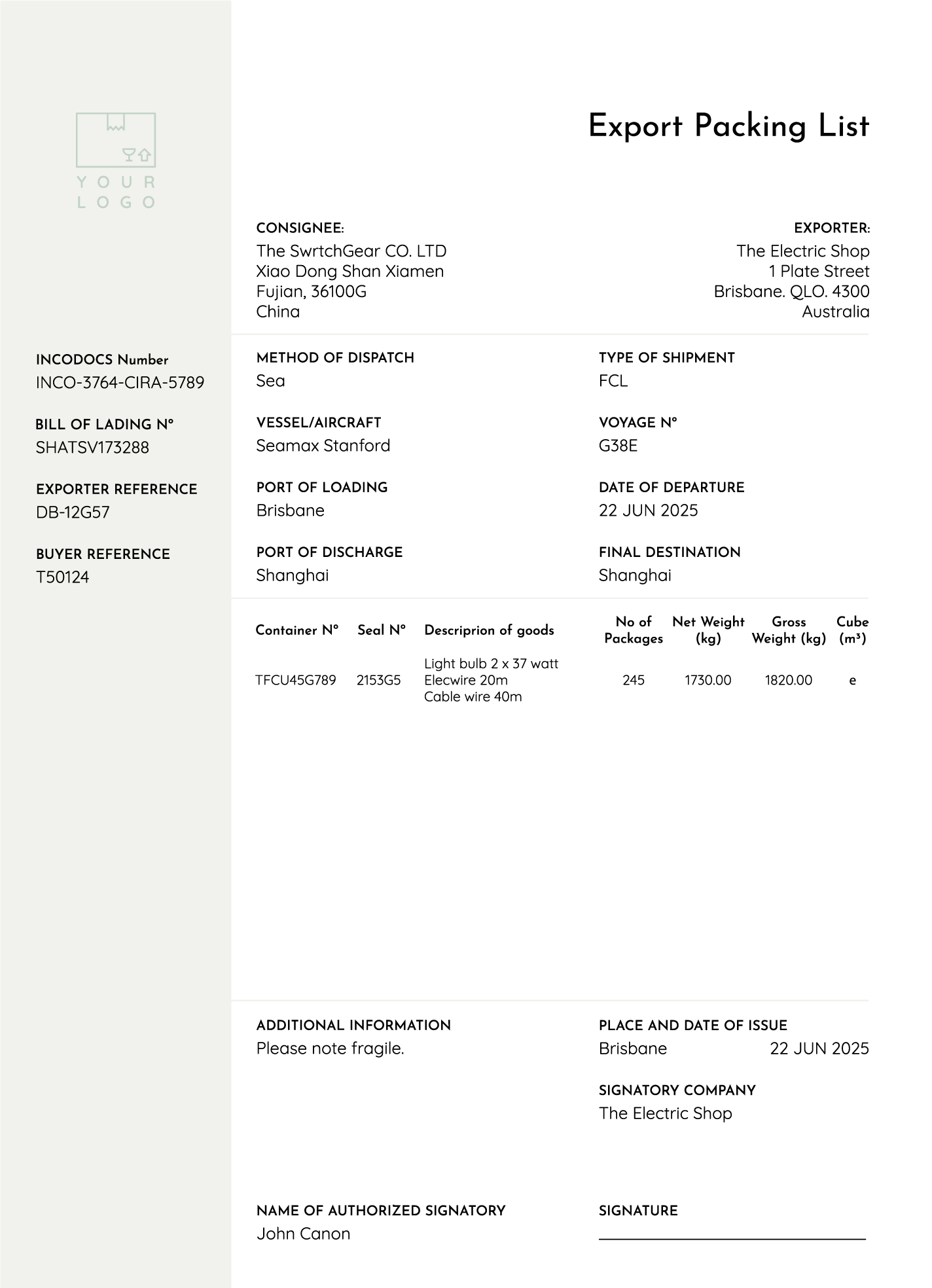
Most packing lists follow a similar structure, but the level of detail may vary based on the buyer or country. Here’s a more detailed example for a garment export:
| Carton No. | Style No. | Description | Color | Size | Qty/Carton | Pcs/Polybag | Net Wt (kg) | Gross Wt (kg) | Dimensions (cm) |
|---|---|---|---|---|---|---|---|---|---|
| 1/10 | 202 | Women’s Blouse | White | S | 30 | 5 | 3.6 | 4.0 | 55x35x25 |
| 2/10 | 202 | Women’s Blouse | White | M | 30 | 5 | 3.7 | 4.1 | 55x35x25 |
| 3/10 | 202 | Women’s Blouse | White | L | 30 | 5 | 3.8 | 4.2 | 55x35x25 |
This format gives everyone in the supply chain a clear view of what is inside each carton.
Practical tip: If you have many items in a single carton, you can add a breakdown column showing how many pieces of each size or color are inside.
Non-obvious insight: Some buyers want a summary at the end of the packing list showing total pieces by style, color, and size. This helps their warehouse staff plan storage and sales.
Credit: gdoc.io
Common Mistakes When Preparing Garment Packing Lists
New exporters often make mistakes that can cause problems at customs or with buyers. Here are the most common ones and how to avoid them:
- Missing or incorrect carton numbers: If carton numbers are skipped, repeated, or missing, it confuses everyone. Always number every carton clearly and sequentially.
- Totals do not match the invoice: If the number of pieces or cartons on the packing list does not match the commercial invoice, customs may stop your shipment.
- Wrong size or color breakdowns: Buyers might reject shipments if they receive the wrong size or color mix. Always double-check with the production and packing teams.
- Inaccurate weights and dimensions: Understating weights can lead to extra freight charges or even shipment refusal. Measure and weigh every carton correctly.
- Forgetting to sign or date: An unsigned packing list may not be accepted by customs. Always have an authorized person sign and date it.
- Not following buyer’s format: Some buyers have strict requirements. If you use your own format when a buyer has given theirs, the shipment may be delayed.
- Leaving out special instructions: If garments need special care (like “keep dry” or “do not stack”), not mentioning it on the packing list can damage your goods.
Example:
A company sent a shipment with cartons numbered 1, 2, 4, 5. Carton 3 was missing. Customs noticed the gap and held the shipment for a full count. The exporter had to pay extra for warehouse storage while the issue was resolved.
Practical tip: Use a checklist to verify each carton is included and labeled before finalizing your list.
Non-obvious insight: If you change your packing plan at the last minute, update both the physical labels and the packing list—never just one.
Tips For Making A Professional Garment Packing List
Over the years, experienced exporters have learned some useful tips for making packing lists accurate and professional:
- Always use clear and consistent terminology for styles, colors, and sizes.
- Use Excel or a similar tool to create your packing list; this reduces manual errors.
- Cross-check the packing list with the carton labels and the invoice before finalizing.
- If you are shipping to multiple destinations, prepare separate packing lists for each location.
- Keep a copy of every packing list for your records. This is important for claims or disputes.
- If in doubt, ask your buyer for a sample or template packing list.
- Use weight and dimension scales that are regularly checked for accuracy.
- For very large shipments, consider adding a summary section at the end of the packing list, showing total quantities by style, color, and size.
Practical tip: Keep digital and paper copies of your packing lists. If your computer system fails, you’ll still have records.
Non-obvious insight: Some warehouse teams use the packing list to plan unloading. If you mention heavy or fragile cartons, they can handle these first and avoid damage.
Example:
“cartons 15–18 Contain Jackets With Glass Buttons. Handle With Care.”
Credit: www.template.net
How Packing Lists Differ By Country Or Buyer
Not all packing lists are the same. Different countries, buyers, or even freight forwarders may have their own requirements.
Country-specific Requirements
For example, shipments to the United States often need a detailed breakdown by SKU (stock-keeping unit), while shipments to the European Union may require extra information about fiber content or origin.
Some countries require all weights and sizes in metric units (kilograms, centimeters), while others use imperial units (pounds, inches).
Example:
A shipment to the US shows weight in pounds and carton size in inches. A shipment to France uses kilograms and centimeters.
Some countries, like Russia, require the packing list to be in the Russian language, while Middle Eastern countries may want the document in both English and Arabic.
Buyer-specific Preferences
Large retailers like Walmart or Zara may provide strict templates, even specifying the font size or language to use. Some buyers want the packing list emailed before the shipment leaves, while others require a physical copy with the goods.
Some buyers require a barcode for each carton, which must match the carton number on the packing list. Others may want the list to show the “store allocation” for direct-to-store shipments.
Practical tip: Always check the buyer’s manual or ask the buyer’s logistics team for special packing list rules before finalizing the shipment.
Freight Forwarder And Shipping Line Needs
Some shipping lines need a cargo summary with total weights and dimensions for space planning. If you are shipping by air, the list may need to be even more detailed, as air freight is charged by both weight and size.
Example:
A freight forwarder may ask for a summary table:
Total Cartons: 120
Total Net Weight: 480 Kg
Total Gross Weight: 510 Kg
Total Volume: 4.8 Cubic Meters
Non-obvious insight: For dangerous goods or garments with batteries (like heated jackets), the packing list must show “contains lithium batteries” for air cargo compliance.
Tip: Always check with your buyer and freight agent before preparing the packing list.
Example Of Garment Packing List For Different Scenarios
Let’s look at how a packing list might change for different types of orders.
Scenario 1: Solid Packing For A Single Store
A buyer orders 600 men’s polo shirts, all navy, all size L, to one store. The packing list is simple:
- 10 cartons, 60 pieces each
- All cartons contain the same style, color, and size
Packing List Example:
| Carton No. | Style | Color | Size | Qty/Carton | Net Wt (kg) | Gross Wt (kg) | Dimensions (cm) |
|---|---|---|---|---|---|---|---|
| 1/10 | 101 | Navy | L | 60 | 12.0 | 12.5 | 60x40x30 |
| … | … | … | … | … | … | … | … |
| 10/10 | 101 | Navy | L | 60 | 12.0 | 12.5 | 60x40x30 |
Scenario 2: Assorted Packing For Multiple Stores
A buyer orders 1,200 pieces in three colors and three sizes, to be distributed to four stores. Now, the packing list must show:
- Separate packing lists for each store (location)
- Each carton includes a mix of sizes and colors
- Carton numbers are unique for each store
Packing List Example for Store A:
| Carton No. | Style | Color | Size | Qty/Carton | Net Wt (kg) | Gross Wt (kg) | Dimensions (cm) |
|---|---|---|---|---|---|---|---|
| 1/5 | 101 | Navy | M | 10 | 2.0 | 2.2 | 40x30x25 |
| 1/5 | 101 | White | L | 15 | 3.0 | 3.3 | 40x30x25 |
| 1/5 | 101 | Red | XL | 5 | 1.0 | 1.1 | 40x30x25 |
(repeat For Each Store.)
Scenario 3: Mixed Styles And Special Packing
A buyer orders different garments: shirts, trousers, and jackets. Some are delicate and need special packing (e.g., jackets on hangers). The packing list must:
- Separate items by style and packing method
- Note special instructions (e.g., “on hangers,” “folded,” “polybagged”)
- Include carton numbers for each packing type
Packing List Example:
| Carton No. | Style | Description | Packing Method | Qty/Carton | Special Notes |
|---|---|---|---|---|---|
| 1/5 | 201 | Shirt | Folded | 40 | – |
| 2/5 | 202 | Trouser | Folded | 35 | – |
| 3/5 | 203 | Jacket | On Hanger | 20 | Handle with care |
Practical tip: Label cartons for special packing methods (e.g., “Carton 3/5 – Jackets on Hanger”) for easy warehouse identification.
Packing List Vs. Other Export Documents
A packing list is often confused with other documents like the commercial invoice or the bill of lading. Here’s a quick comparison:
| Document | Main Purpose | Key Information | Who Uses It? |
|---|---|---|---|
| Packing List | Lists what is inside each carton | Carton number, style, size, quantity, weights | Customs, buyer, shipping line |
| Commercial Invoice | Shows value of goods sold | Price, total value, payment terms | Customs, buyer, bank |
| Bill of Lading | Proof of shipment and contract of carriage | Shipper, consignee, vessel, goods description | Shipping line, bank, customs |
Insight: Only the packing list shows how the goods are distributed inside the shipment. Customs and warehouse teams rely on it for physical checks.
Non-obvious insight: In case of damage or shortage, the packing list is your best evidence to claim insurance, because it proves how many pieces were shipped in each carton.
How To Automate Garment Packing List Creation
For large exporters, manual packing lists can be slow and error-prone. Today, many companies use ERP (Enterprise Resource Planning) systems or specialized garment export software to automate packing list creation.
These systems can:
- Pull order and production data directly into the packing list
- Calculate totals and check for discrepancies
- Generate packing list PDFs in buyer-required formats
- Integrate with carton label printing
Automating the process reduces human error and speeds up documentation.
Example:
A company uses an ERP system that connects with the warehouse. When packing is finished, the system automatically creates the packing list with the latest data. If a carton is missing, the system highlights the error before printing.
Practical tip: Even with automation, someone must check the final packing list against the actual goods shipped.
Non-obvious insight: Some software can send the packing list directly to buyers and freight forwarders, saving you time and reducing email mistakes.
Credit: incodocs.com
Non-obvious Insights For Perfect Packing Lists
Many beginners miss these two important points:
- Packing List as a Sales Tool: If your packing list is neat, accurate, and professional, buyers trust your shipment quality. It reflects your company’s reliability and attention to detail.
- Hidden Compliance Risks: Some countries have strict rules on carton weights, labeling, or even the language used. If your packing list or labels do not follow these, your shipment could be delayed or even destroyed by customs. Always check the latest import rules for your buyer’s country.
Extra insight: Packing lists can help you track patterns in claims or complaints. If buyers repeatedly say they received the wrong sizes, checking your old packing lists may reveal where the problem started.
Practical tip: If you regularly ship to new countries, keep a folder with different packing list formats and requirements for each country or buyer.
Real Example: Packing List Error And Costly Delay
A small Bangladeshi garment exporter once shipped 20 cartons of shirts to Germany. The packing list showed all cartons contained 60 shirts, but one carton actually had only 55. German customs found the mistake, and the shipment was held for 10 days.
The buyer had to pay extra warehousing fees, and the exporter lost future orders.
Lesson: Always check that the actual carton contents match your packing list exactly.
Practical tip: Before final sealing, open a few random cartons and count the pieces. Even if your staff is careful, mistakes can happen during packing.
Non-obvious insight: Some buyers do 100% inspection if they find a mistake in one carton. A single error can lead to a full shipment review.
Frequently Asked Questions
What Is The Main Difference Between A Packing List And A Commercial Invoice?
The packing list shows the physical breakdown of the shipment—what is in each carton, including style, color, size, and quantity. The commercial invoice is a financial document that lists the value and price of the goods for payment and customs duty calculation.
The packing list helps customs and warehouse teams during physical checks, while the invoice is mostly for financial and legal purposes.
Can I Use The Same Packing List Format For All Buyers?
Not always. Many buyers and countries have their own required formats or additional information needs, such as language, units of measure, or breakdown details. Before shipping, ask your buyer if they have a preferred template, and check with your freight forwarder for any special requirements.
Practical tip: If you work with multiple buyers, keep a folder of their approved packing list templates.
What Happens If The Packing List Has A Mistake?
Errors can cause customs delays, shipment holds, or even rejection. If the quantities, weights, or product details do not match the invoice and the actual contents, customs may inspect the shipment more closely. This can lead to extra costs, penalties, or unhappy buyers.
Double-check all details and ensure carton numbers match the physical boxes.
Do I Need To Include Net And Gross Weight For Each Carton?
Yes, most buyers and shipping companies require both net weight (weight of products only) and gross weight (products plus packaging) for each carton. This is important for correct freight charges and for customs clearance. Always use accurate, calibrated scales.
Where Can I Find Sample Packing List Templates For Garment Export?
Many industry groups and logistics companies provide free templates. You can also ask your buyer or freight forwarder for a sample. For official guidance, visit the International Chamber of Commerce website at [ICC Incoterms](https://iccwbo.org/resources-for-business/incoterms-rules/incoterms-rules-2020/). These resources offer examples and tips for proper export documentation.
Practical tip: Start with a basic template and add more details as your buyers or countries require.
—
Creating a clear, accurate, and complete garment packing list is not just paperwork—it is a critical step to ensure your products move smoothly across borders and reach your customers on time. With good planning, careful checks, and the right format, you can avoid costly mistakes and build strong relationships with your international buyers.
By making your packing list professional and precise, you show buyers and customs that your business is reliable. This increases trust, reduces delays, and can help you win more orders in the future. Remember, a great packing list is your silent ambassador in the world of international trade.